

Core Concepts
This page explains ByteSeek's basic model: groups, pools, multipliers, balance and quota — and the gates a request passes through before it is allowed (or rejected).
Glossary
Groups
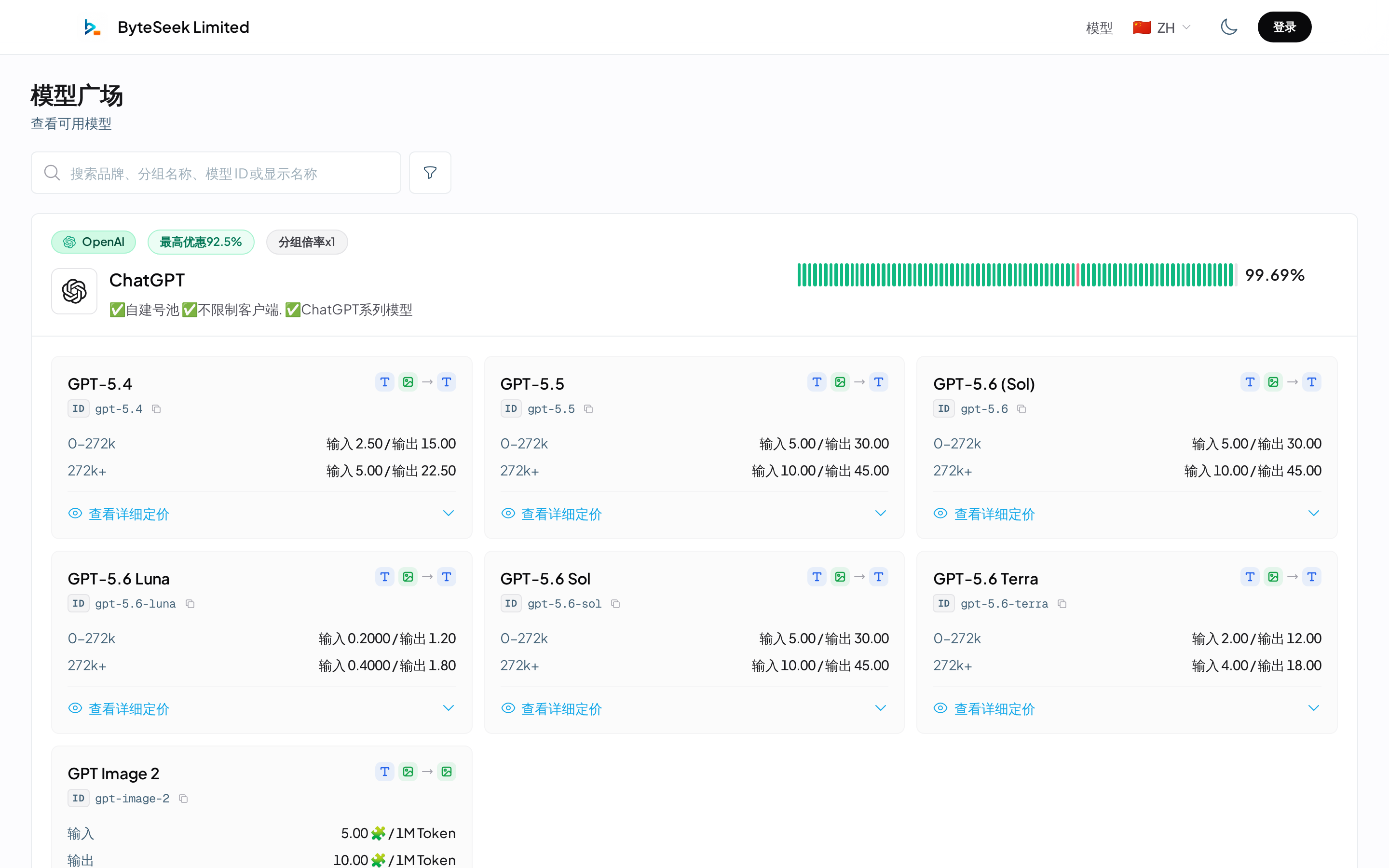
The group is the most important concept — it determines four things at once:
- Which models you can use — the model must be in the group's list;
- At what price — base price × group multiplier;
- Which protocol format is accepted — OpenAI, Anthropic and more (full list in API Endpoints), and it must match your client;
- Which pool serves you — determining capacity and peak-hour behaviour.
Creating an API key requires picking a group. To use several groups with one key, see Composite Keys.
Format groups
Some models are split into two groups by protocol format, e.g. "DeepSeek (OpenAI format)" and "DeepSeek (Anthropic format)". Choosing the wrong format gets you a 403 — confirm what protocol your client speaks first, see API Endpoints.
Client-restricted groups
Some groups only accept specific clients (e.g. Codex-only, Claude-Code-only); other clients receive 403. Every group in the model plaza carries an explanatory label — similarly named groups can have completely different restrictions.
Group ≠ subscription plan
A group is a property of an API key; a subscription plan is a payment method for the account. Names may look similar, but they are unrelated: quota from any plan can be spent on any group you have access to.
Pools
A pool is the set of upstream accounts behind a group. One pool can serve several groups, each with different multipliers and client restrictions. Pool capacity and health determine peak-hour queueing; see each group's notes in the model plaza.
API keys and scope
Scope is fixed at creation time and toggled in the top-right corner of the API Keys page:
- A regular key binds one group; write the model ID directly when calling.
- A composite key binds several groups; write
prefix/modelID, see Composite Keys.
Cost calculation
A request is priced in three parts — input, output, cache:
- Cache hits are billed at the cache price, usually far below the input price;
- Composite keys are billed by the group the prefix actually hits;
- Fast Mode uses the high-priority lane at roughly 2× the regular price.
Deduction order: subscription first, then balance. The subscription expiring soonest is consumed first; once subscriptions are exhausted, the balance takes over. Details in Billing.
The five gates of a request
Every request passes these gates in order — check them in the same order when troubleshooting:
Status codes and messages for each gate are in Error Codes.
Related
- Create an API Key — pick a group, generate a key
- Billing — multipliers, subscriptions and balance
- API Endpoints — the URLs your client needs
- Troubleshooting — locate failures by symptom